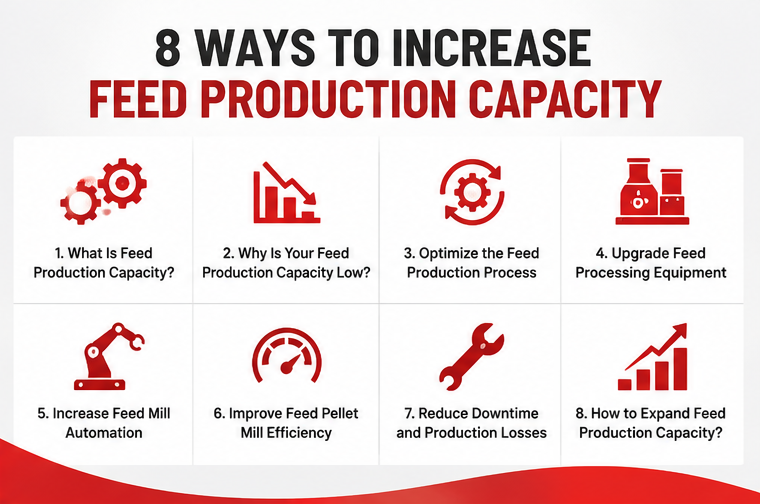
How to effectively improve feed production capacity
- I. Core definition of feed production capacity
- II. Core reasons for low feed production capacity
- III. Optimize feed production process and improve production capacity
- IV. Upgrade feed processing core equipment to improve production capacity
- V. Improve the automatic production level of feed mills
- VI. Improve the operation efficiency of pellet machine and strengthen the production base
- VII. Reduce downtime loss and recover invisible production capacity
- VIII. Scale expansion plan for feed production capacity
- Summary: Systematically realize long-term improvement of feed production capacity
With the continuous expansion of animal husbandry, aquatic products and pet food industries, the market demand for feed has steadily increased, and feed processing plants are generally faced with multiple pressures of improving quality, increasing production and reducing costs. Production capacity directly determines the market competitiveness, order acceptance ability and profit level of feed enterprises, and is also the core cornerstone of large-scale development of enterprises. Most feed factories do not need to build new factories and transform the whole line.
By clarifying the definition of production capacity, checking production bottlenecks, optimizing process flow, upgrading core equipment, landing automatic control, reducing production losses and other systematic means, they can efficiently improve production capacity, stabilize product quality and control production costs. This article will systematically explain the core logic, common pain points and optimization schemes of feed production capacity improvement, so as to provide professional reference for feed enterprises to increase production efficiently and steadily.
I. Core definition of feed production capacity
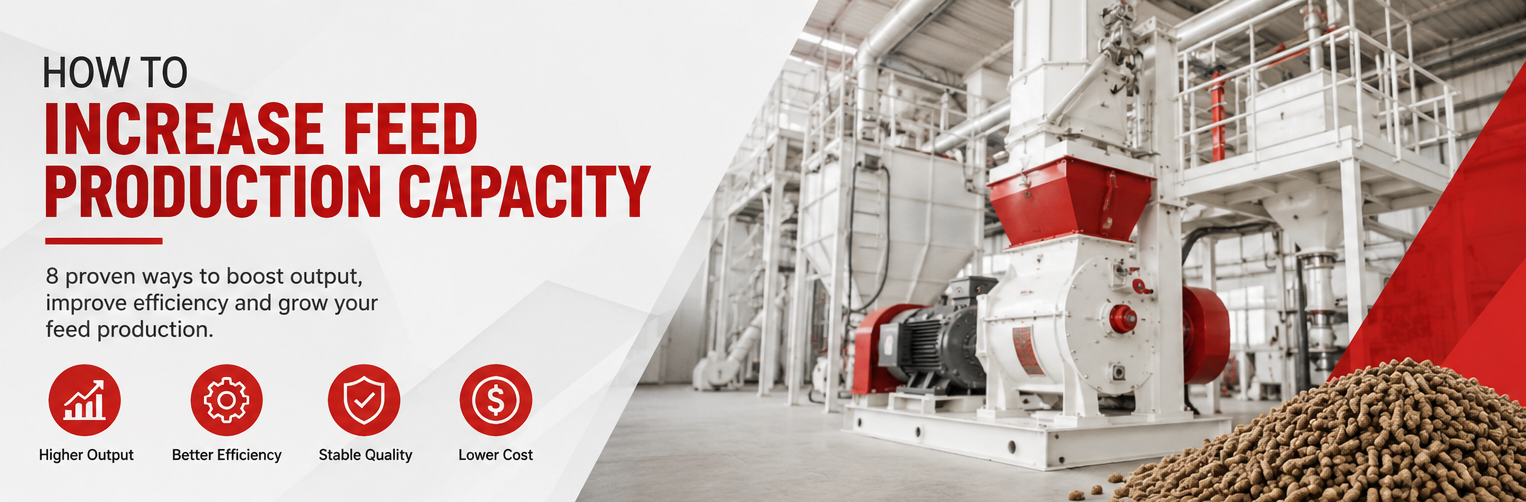
Feed production capacity refers to the maximum feed output that can be produced by feed processing plants in a fixed cycle, relying on existing equipment, technology and site conditions. It is the core index to measure the production strength, capacity utilization rate and supply capacity of enterprises, which directly affects the order delivery and profit scale. The industry has a unified capacity measurement standard, which can realize the horizontal comparison of factories of different scales, which is the core basis for enterprises to formulate production plans, upgrade equipment and expand production capacity. Clarifying the core definition and calculation logic of production capacity can effectively avoid common problems such as blind equipment investment, idle production capacity and misplaced planning.
Feed industry production capacity is mainly divided into two categories: design installed capacity and actual available capacity. The difference between the two is the core reason for the waste of production capacity and substandard output of most feed factories, and it is also the key breakthrough point for enterprises to tap the potential of increasing production. In the real production scenario, the equipment can hardly reach the theoretical maximum production capacity. The superposition of various production losses forms a fixed capacity gap. Accurate distinction between the two types of production capacity is the basic premise for checking bottlenecks and optimizing production.
Designed installed capacity
Designed installed capacity, also known as theoretical capacity, is the rated output calibrated by equipment manufacturers according to equipment parameters and continuous and stable operating conditions, often measured by output per hour (TPH). This production capacity is calculated based on ideal production conditions, assuming that there is no downtime, no fault, no process loss and no manual error in the whole production line. It only represents the theoretical output upper limit of equipment hardware and does not adapt to real and complex production scenarios. It is the basic reference standard for production line planning.
actual available capacity
The actual available production capacity is the effective output that can be stably landed in the feed factory, the real production capacity level after deducting all kinds of production losses, and the core basis for the actual supply of the enterprise. The industry uses 80% as a productivity efficiency benchmark coefficient to adapt to conventional production losses.
Most equipment manufacturers reserve capacity redundancy, such as calibrating a production line with a capacity of 50 tons/hour, and the actual configuration of the equipment can reach 60 to 75 tons/hour, so as to offset production losses and ensure that the actual output meets the standard.
The losses affecting the actual production capacity cover the whole production process, mainly including planned maintenance and sudden failure shutdown of equipment, loss of multi-formula switching, quality inspection time, compliance inspection shutdown, fluctuation of moisture density of raw materials, difference of manual operation efficiency and unreasonable shift scheduling, etc. Accurate statistics on the proportion of various losses can quickly locate the production loss points and realize accurate optimization.
II. Core reasons for low feed production capacity
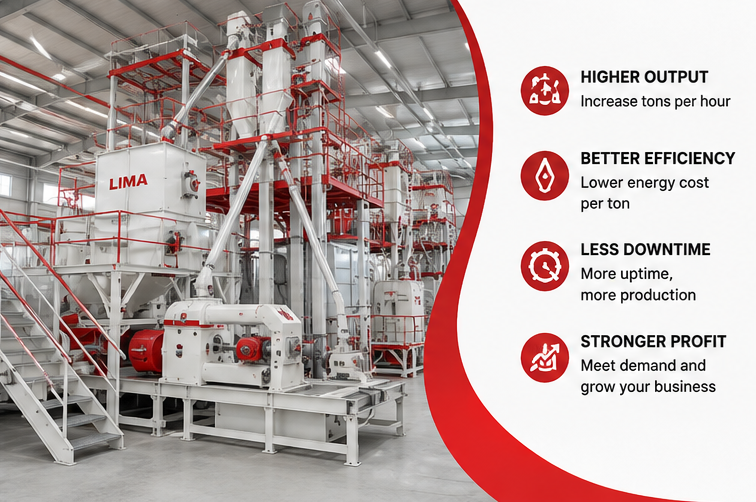
At present, most feed mills are generally faced with the problems of order increment and insufficient production capacity, and the capacity utilization rate has been lower than 80% of the industry benchmark for a long time. They can only rely on overtime production to make up for the gap and push up production costs.
The low feed production capacity is not caused by a single fault, but the result of long-term superposition of multi-dimensional fine constraints such as equipment, process, automation, raw materials and supporting facilities. Comprehensively investigate all kinds of core incentives, unlock hidden production capacity from the root cause, and realize stable production increase at low cost.
Equipment bottlenecks restrict production capacity across the board
Bottleneck of equipment is the primary cause of insufficient feed capacity. Feed production line is series structure, single equipment efficiency lag, will lock the production capacity of the whole production line, forming a typical barrel effect. Most old production lines have problems such as mixed old and new equipment, mismatched parameters, unbalanced rhythm of each section, etc., which seriously restrict the overall output release.
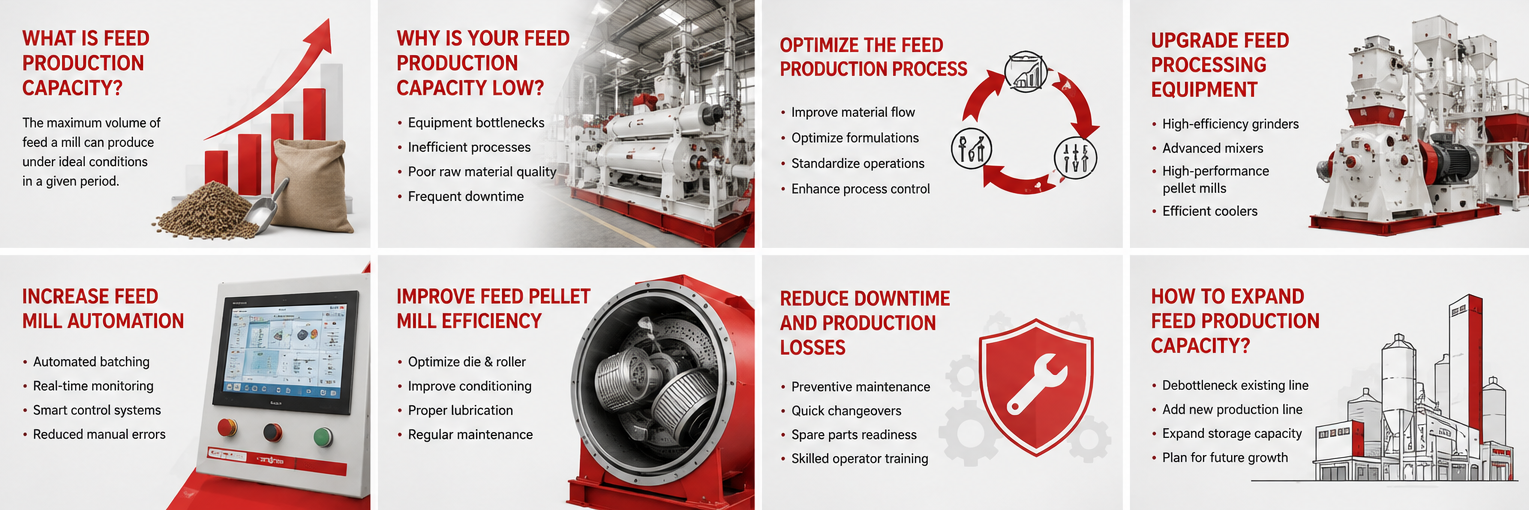
Common equipment bottlenecks are concentrated in the core section: old crushing equipment is worn out and aging, crushing efficiency is insufficient, and it cannot match the rhythm of mixing process; the batch cycle of mixer is too long, resulting in long-term standby of rear granulation equipment; the configuration of granulator die roller and the adaptability of conditioning system are poor, which directly limits the core discharge efficiency; the capacity of cooling and crushing equipment is insufficient, resulting in material accumulation and blockage, which forces the front equipment to slow down. When a single equipment only exerts 60%-70% of the theoretical capacity, the production of the whole line is simultaneously limited. Targeted upgrades to core equipment can quickly increase overall production capacity by 20%-40% without significant adjustments to production line layout.
Inefficient process design and material flow
Equipment hardware standards do not mean that production capacity can be fully released, production line material flow fluency is the key hidden factor determining actual production capacity. Many feed mills have perfect hardware configuration, but the process layout and conveying design are unreasonable, resulting in material flow stagnation and ineffective waiting time, resulting in continuous production waste.
Common circulation problems include small specification of conveying and lifting equipment, unreasonable conveying route, material transfer speed lagging behind production rhythm; insufficient buffer storage capacity in the middle of the section, material interruption or accumulation; complicated manual semi-automatic batching process, long waiting time for material replacement and batching; unreasonable plant layout, cross congestion of operation lines, slowing down the overall production rhythm. Compared with replacing large equipment, optimizing layout, adding cache and upgrading transportation system can unlock a large amount of hidden production capacity at a lower cost.
Lack of automation and real-time management and control systems
Manual and semi-automatic production mode has strong production fluctuation, which is an important reason for low production capacity and unstable quality of small and medium-sized feed mills. Manual operation depends on experience and cannot accurately control core parameters such as steam, temperature and material retention time. In order to avoid quality risks, operators usually control the speed conservatively, resulting in long-term failure of equipment to operate in the optimal capacity range, resulting in serious idle capacity.
The production line lacking intelligent control system cannot monitor and automatically correct production deviation in real time, which is easy to cause material waste, equipment jamming, abnormal quality, and increase shutdown and rectification loss. The automatic production line equipped with PLC intelligent control system and formula management system can accurately control the whole process parameters, eliminate manual errors, keep the equipment close to the designed production capacity, and realize double optimization of production capacity and quality.
Fluctuation of raw materials and unreasonable formulation design
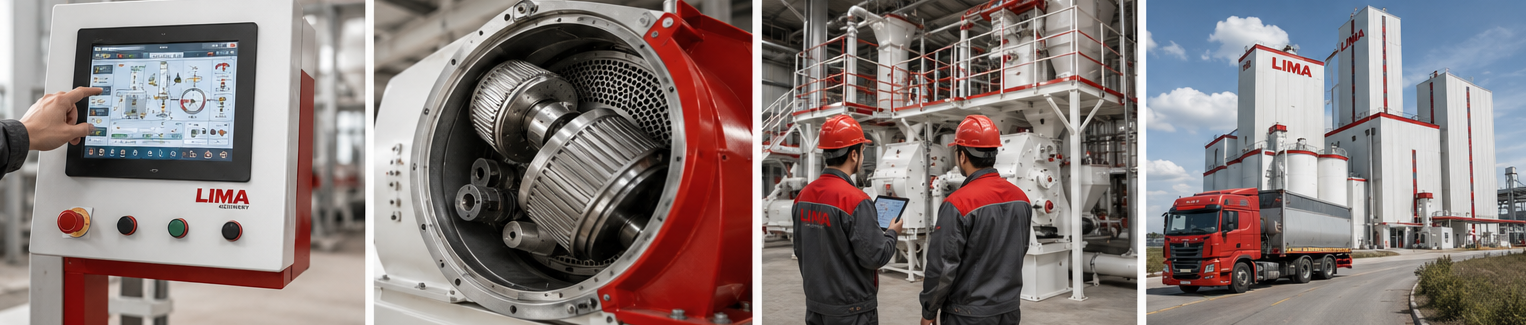
Raw material characteristics and formulation design are easily overlooked productivity constraints. High fiber, high fat formula crushing and granulation is more difficult, will directly reduce the core equipment efficiency; raw material moisture, density fluctuation is too large, will lead to production parameters adaptation failure, material blockage, finished products unqualified, rework rate increased and other problems. At the same time, the pretreatment process is not in place, and the granulation mold does not match the formula, which will further compress the effective production capacity. By optimizing the pretreatment process, matching the exclusive mold and adjusting the grinding particle size, a large amount of hidden production capacity can be recovered without adding new equipment.
At the same time, many feed factories have problems such as inadequate pretreatment process, mismatch between pelletizing mold selection and product formula, and failure to adjust production parameters according to formula characteristics to further reduce effective production capacity. Without adding new equipment, by optimizing the raw material pretreatment process, matching the exclusive mold specifications, adjusting the particle size distribution of the material, the production adaptability can be effectively improved and a large amount of hidden production capacity can be recovered.
III. Optimize feed production process and improve production capacity
Process optimization is the method of increasing production with the lowest investment and the highest return. High-quality equipment must rely on scientific process system to release all performance, if the process connection is not smooth, parameters are unreasonable, high-end equipment will also have low production capacity, high energy consumption, quality fluctuation and other problems. By sorting out the whole process, eliminating production resistance and optimizing process connection, double-digit capacity improvement can be realized without adding new equipment or expanding plant, and unit energy consumption and labor cost can be reduced at the same time.
Sort out and perfect the whole process production process map
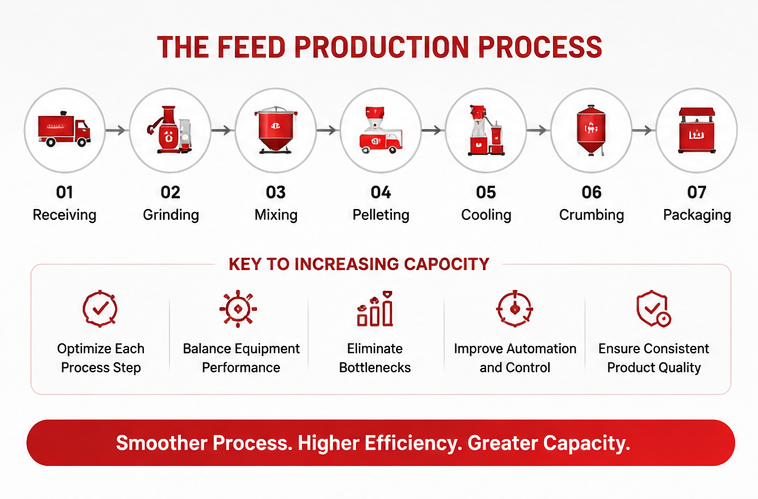
Before process optimization, it is necessary to complete the whole process sorting, covering the whole process from raw material feeding, ingredient crushing, mixing and tempering, granulation and cooling, screening and packaging to finished product delivery, marking material transfer, cache storage and process control nodes, counting the production time, standby loss and quality fluctuation data of each section, establishing accurate data baseline, accurately locating the production capacity loss point, and ensuring the accurate implementation of subsequent optimization measures.
Optimize crushing process to ensure productivity and uniformity
Grinding process is the basis of feed production, grinding efficiency and particle size uniformity directly determine the stability of subsequent processes. To optimize the grinding process, it is necessary to accurately match the configuration of screen and hammer, adapt to the target particle size standard; control the linear speed of hammer and air intake to prevent excessive grinding and screen clogging; stabilize the feed speed to keep the mill running in the rated high efficiency range. A new generation of crushing equipment equipped with automatic screen changing and real-time monitoring functions can greatly reduce downtime losses and lay the foundation for efficient production of the whole line.
Compressing mixing cycle improves mixing quality
In batch production line, the cycle period of mixer directly determines the production rhythm of the whole line, and the low efficiency of mixing process is the core common problem of low production capacity. The core of process optimization is to compress batch time and ensure mixing uniformity. By matching equipment model, reasonably controlling material filling amount, optimizing feeding and unloading process, adjusting trace ingredients and liquid addition sequence, the process turnover time can be effectively shortened. Equipped with high-precision weighing system and efficient mixing equipment, it can realize two-way improvement of production capacity and quality.
Intensify working efficiency of conditioning and granulation section
Quenching and granulation are the core sections that determine the maximum production capacity of the whole line. Quenching effect directly affects granulation efficiency and finished product durability. The key points of optimization are to stabilize steam quality, accurately control material conditioning time, and realize full gelatinization of starch; match mold specifications according to product formula, optimize die roller gap and feed speed, and avoid equipment overload or no-load waste of production capacity. Double-shaft tempering equipment and a new generation of die roll structure can significantly improve the discharge efficiency under the premise of stable quality, and can maintain high-efficiency production status for a long time with energy consumption monitoring.
Capacity matching degree of post-balance process
Cooling, screening, packaging and other post-stage processes are easy to be ignored, which are typical hidden production bottlenecks. Insufficient production capacity in the post-stage will directly offset the production increase results optimized in the previous stage. The cooling equipment is too small to force the granulator to slow down, the screening efficiency leads to the accumulation of reworked materials, and the packaging lag causes the finished product congestion. Process optimization needs to focus on balancing the production capacity of the entire line, matching the production capacity of the front and back sections, reserving sufficient material buffering capacity, completely eliminating process constraints, and ensuring uniform and efficient operation of the entire line.
Optimize material handling and intermediate buffer systems
Smooth material transportation and reasonable intermediate buffer layout are the key to continuous operation of production line. Many production line equipment parameters meet the standard, but the conveying and lifting equipment specifications are insufficient, and the cache capacity is limited, resulting in material transfer lag, process interruption, and frequent start and stop of equipment. Optimize the conveying layout, upgrade the matching accessories, control the cache level, and match the transfer rhythm, which can minimize the invalid standby and fully release the capacity of the stock equipment.
Intelligent real-time process control
Manual parameter adjustment has hysteresis and subjectivity, conservative operation will seriously limit the release of production capacity. Intelligent process control, relying on PLC control system and formula management system, can realize automatic sequencing of processes, real-time monitoring of parameters, dynamic regulation of equipment status, and automatic correction of production deviation. The system can automatically adjust parameters during formula switching, greatly reducing the downtime of type change and effectively improving effective production capacity.
Optimizing process parameters by matching formula characteristics
Fixed process parameters can not meet the needs of multi-category feed production, special formula using conventional process will have low efficiency, high rework rate, poor quality and other problems. Joint nutrition and technology personnel, according to the raw material characteristics and nutrition standards of different formulas, customize the exclusive grinding particle size, addition ratio, conditioning parameters and mold specifications to achieve accurate matching between the process and the product, and improve the production adaptability and overall production capacity under the premise of zero equipment investment.
IV. Upgrade feed processing core equipment to improve production capacity
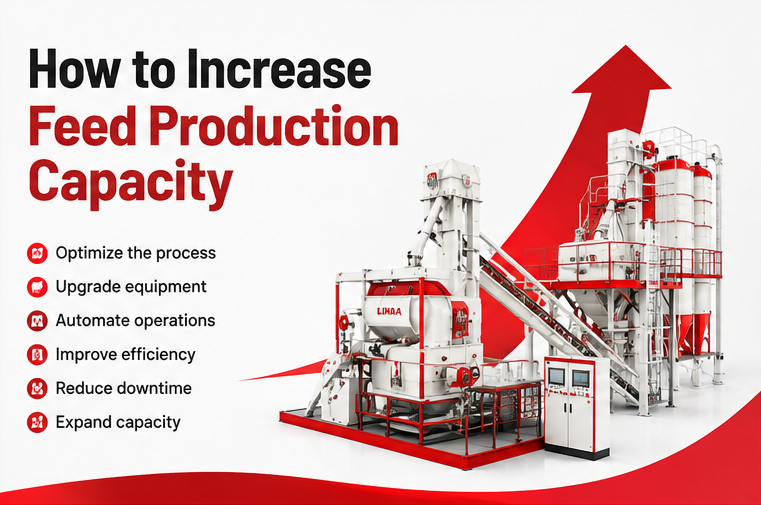
Equipment aging, mismatched specifications, and performance degradation are the core hardware reasons for substandard production capacity. Even if the long-term operation equipment is well maintained, the operation efficiency will decline year by year, and it cannot meet the market increment and quality upgrading demand. Targeted equipment upgrades are the most direct and efficient means of increasing production. They can not only replace old equipment, but also reconstruct the production line capacity balance system, allowing each section to operate synergistically and efficiently, achieving all-round optimization of production capacity, energy consumption, and stability.
Accurate identification of equipment upgrade just need signal
Enterprises do not need to change equipment blindly, and can accurately judge upgrading nodes through production data and equipment status. When the actual output fails to meet the standard for a long time, the unit energy consumption continues to rise, the quality fluctuates greatly, the equipment fails frequently, the new formula cannot be adapted, and the labor cost remains high, it indicates that the equipment has formed a capacity bottleneck, and it is necessary to carry out targeted upgrading and transformation to avoid ineffective capital investment.
Prioritize upgrades to high-return core equipment
Equipment upgrade needs to focus on core bottlenecks, give priority to landing high-return projects, and do not need to be replaced all at once. The core upgrade direction covers four major sectors, which can quickly realize capacity gain.
Grinding system upgrade: new generation of efficient grinding equipment with automatic screen changing and intelligent wind control functions, more uniform grinding particle size, less downtime loss, improve the production rhythm of the whole line from the source, and reduce unit energy consumption.
Mixing equipment upgrade: high-efficiency paddle, screw belt mixer with intelligent weighing and micro-automatic addition system, can greatly reduce batch cycle time, improve the accuracy of ingredients and mixing uniformity, solve the problem of slow down the rhythm of the whole line in the mixing section.
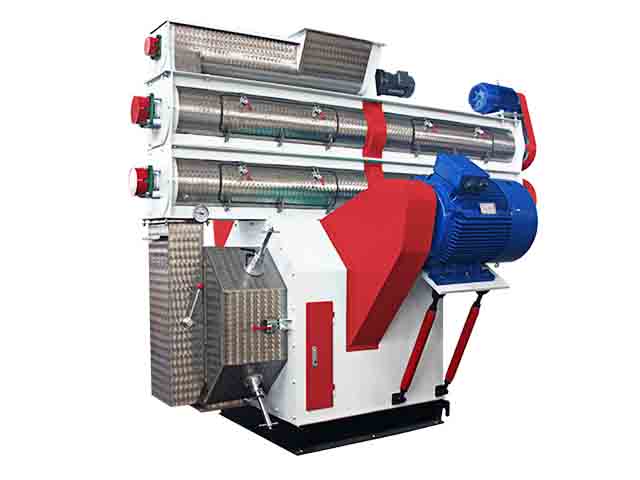
Upgrading of conditioning and granulating equipment: As the core production section, the dual-axis conditioning equipment can extend the conditioning time and improve the uniformity of conditioning. The new generation of granulator with rapid die change and optimized die roll structure can improve the discharge efficiency by 20%-40% and stabilize the finished product quality. It is the most significant upgrade plate for increasing production.
V. Improve the automatic production level of feed mills
Manual and semi-automatic production mode is the important reason for idle production capacity, quality fluctuation and high cost in small and medium-sized feed mills. Manual control efficiency is limited, error is large, easy to lead to inefficient operation of equipment. Fully upgrade the automation system, realize accurate control of the whole process, stabilize continuous production, unlock stock capacity, reduce labor cost, stabilize product quality and build intelligent and efficient production system without adding new sites and equipment.
The core of automatic transformation to increase production advantages
Automatic transformation can optimize all-round enabling capacity: shorten batch cycle, reduce standby time, improve actual effective capacity; unify production standards, eliminate manual deviation, stabilize product quality; make equipment operate continuously and efficiently, reduce unit energy consumption; reduce manual dependence, alleviate production fluctuation caused by personnel flow; shorten formula change downtime, adapt to multi-category production; Real-time monitoring and early warning can reduce sudden failure losses, and long-term implementation can achieve double-digit production capacity increase and significant cost reduction.
Automatic transformation core landing plate
Automatic batching and raw material control: intelligent weighing, formula management and micro-precise dosing equipment, completely eliminate manual batching errors, shorten the preparation time of ingredients, ensure efficient connection of processes, and improve batch production efficiency and material uniformity.
Mixing and process sequencing automation: intelligent system automatically controls the whole process of feeding, mixing and unloading, with equipment linkage and material level monitoring function, eliminating batch standby interval, stabilizing production line rhythm, and making mixing equipment continue to operate efficiently.
Conditioning and granulation control automation: closed-loop control system automatically adjusts steam, temperature, material retention time, dynamically adjusts feed speed according to equipment load, so that granulation equipment can run stably in high efficiency range, maximize core production capacity, and ensure stable finished product quality.
Core points to be controlled for automation project landing: check production bottleneck and equipment adaptability in advance, upgrade old hardware synchronously; build stable data acquisition and communication system; simplify operation interface and supporting personnel training; adopt phased landing mode, give priority to landing high cost performance transformation projects, steadily improve intelligent production system, and ensure effective transformation.
VI. Improve the operation efficiency of pellet machine and strengthen the production base
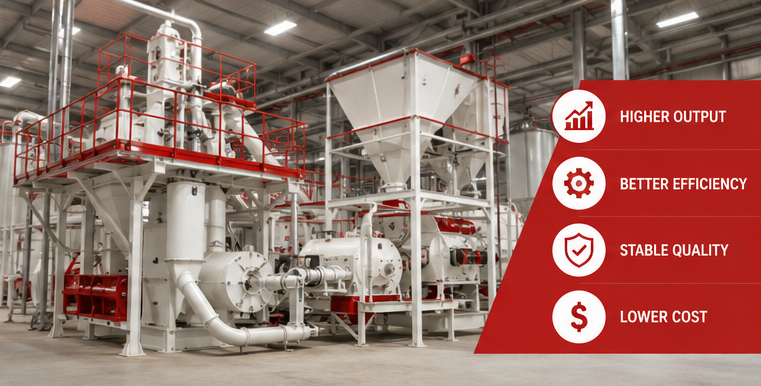
Pellet machine is the core equipment of feed production line, its operation efficiency and stability directly determine the production capacity, quality and production cost of the whole line. The small efficiency improvement of the particle machine will form a full-scale increase in production gain. The core of efficient granulation is to maximize hourly yield and minimize energy consumption under the premise of ensuring feed nutrition and physical quality, which needs to be realized through multi-dimensional fine control of process, accessories, parameters, maintenance and formula.
Control particle machine core efficiency index
Accurate monitoring of core operating indicators is the basis for optimizing granulation efficiency. Core monitoring dimensions include hourly yield, unit energy consumption, granule durability, powder defect rate, die roll service life and equipment efficient load operation ratio. Continuous tracking of data can accurately locate efficiency shortcomings and production loss points, providing data support for refined optimization.
Optimizing Conditioning Process and Tamping Granulation Foundation
Quality conditioning is the basis of efficient granulation, conditioning standards will directly increase equipment load, reduce production capacity and finished product quality. The core of the optimization is to stabilize the steam quality, ensure sufficient conditioning time, and achieve full gelatinization of the starch; allow the steam, liquid and materials to be evenly integrated to ensure uniform conditioning effects; stabilize the temperature and moisture of the materials entering the mold, and eliminate granulation deviations caused by parameter fluctuations. Dual-axis conditioning equipment with precise steam control system, can adapt to multi-formulation stable production.
Precise selection and maintenance of granulation die roll
Die and roller are the key vulnerable parts that determine granulation capacity, energy consumption and quality. According to the product formula, particle specifications accurately match the mold thickness, pore size, pressure relief structure, can effectively reduce granulation resistance, improve discharge speed, reduce energy consumption. Establish a normalized inspection mechanism, replace worn parts in time, accurately adjust the gap between die rollers, and match with a rapid die change system, which can greatly shorten the downtime of maintenance and type change and ensure long-term efficient operation of equipment.
Steady feed rate vs. equipment load
Frequent fluctuation of equipment load is an important inducement for waste of production capacity, high energy consumption and aggravated loss of accessories. Fast and slow feeding will lead to equipment overload or no-load, double loss of capacity and equipment life. Equipped with intelligent feed control system, dynamically adjust the feed speed according to the equipment current and load, which can stabilize the operation condition of the equipment, keep the pellet machine in high efficiency for a long time, and maximize the release of equipment potential.
Formulation adaptation and particle size optimization
Formula structure and grinding granularity directly affect granulation adaptability. Materials with high fiber, high fat formula and uneven granularity have high granulation difficulty and high rework rate, which seriously restricts production capacity. On the premise of guaranteeing nutrition standard, optimizing crushing particle size, adjusting liquid addition point and optimizing formula ratio can significantly improve the granulation effect of materials, improve molding rate and production efficiency, and realize zero equipment investment and increase production.
Reduce downtime losses and optimize replacement processes
Every shutdown of pellet mill will cause irreversible productivity loss, so reducing ineffective shutdown is the key means to increase production. Establish a predictive maintenance system to troubleshoot faults in advance based on equipment temperature, vibration and operating time to reduce sudden downtime; optimize mold change, cleaning and mold change processes, streamline operation steps and shorten planned downtime; realize automatic parameter debugging and rapid process switching based on automation system to maximize effective production time.
Establishment of Long-term Optimization Mechanism of Granule Machine
Establish a long-term efficiency optimization mechanism for granulation stage, dynamically track core parameters such as temperature, moisture, energy consumption and yield based on real-time data, and correct operation deviation in time. The optimal parameters under different working conditions and different formulas are summarized through historical data duplication to form a standardized operation system, continuously iteratively optimize granulation efficiency, and stabilize long-term production gain.
VII. Reduce downtime loss and recover invisible production capacity
Equipment shutdown, abnormal production and material rework are the most hidden and largest capacity losses in feed mills, and are also the core reasons for the substandard production capacity of many high-end equipment production lines. Reducing production loss and improving production stability is the fastest way to increase production with zero hardware investment, which can fully activate the existing production line stock capacity and rapidly improve effective output and production benefit.
Clarify the core types and hazards of shutdown losses
Feed production capacity loss is mainly divided into five categories: unplanned downtime caused by equipment failure and material blockage; planned downtime loss caused by long maintenance operation time; type change downtime caused by multi-formula switching and equipment cleaning; production standby caused by raw material supply and back-end process congestion; unqualified materials caused by parameter deviation and rework scrap loss. Long-term superposition of all kinds of losses, continuous compression of effective production capacity, accurate statistics of loss types and proportions are the prerequisites for optimization and rectification.
Targeted solutions to core downtime triggers
Optimize equipment maintenance mode, abandon passive mode of post-failure maintenance, implement condition monitoring and predictive maintenance, monitor equipment operating parameters by relying on sensors, identify hidden dangers in advance, complete maintenance operations at off-peak, and greatly reduce sudden failure and emergency maintenance time. The new modular equipment accessories are easy to disassemble, which can further reduce maintenance time and improve equipment operation stability.
Streamline the change and cleaning process, aiming at the production needs of multiple categories, equipped with rapid mold change and screen change equipment, supporting automatic cleaning procedures and standardized operation processes, greatly reducing the time spent on changing the type of cleaning. Optimize the layout of intermediate buffer, realize material isolation storage, reduce the interference of changing materials, and further reduce the invalid downtime.
Stabilize the connection between material flow and process, reasonably control the material level of buffer warehouse, stabilize the conveying speed, balance the production capacity of each section, eliminate problems such as material accumulation and supply interruption, reduce frequent start and stop of equipment, slow down standby, ensure continuous and stable operation of production line, and reduce production capacity loss from the process level.
Strictly control abnormal quality shutdown, rely on real-time process monitoring system, accurately control core indicators such as production temperature, moisture, particle durability, etc., timely correct production deviation, reduce unqualified materials and rework scrap problems from the source, improve finished product yield, and reduce production stagnation caused by quality rectification.
All-round loss control strategy for landing
All-round loss control needs systematic measures: carry out predictive planned maintenance to improve the stable operation time of equipment; select high-availability equipment to adapt to complex working conditions and reduce fault loss; realize automatic type change and process control relying on intelligent system; optimize cache layout, realize process decoupling and capacity balance of the whole line; set up data visualization kanban to realize abnormal warning and rapid rectification; standardize operation flow, carry out all-staff training and reduce artificial loss. Multi-action synergy can minimize ineffective production time.
Long-term control consolidates the achievements of production increase
Establish a normalized loss monitoring and re-listing mechanism, continuously count core data such as comprehensive efficiency of equipment, failure time, replacement time, rework rate, etc., regularly re-list optimization, dynamically check new production capacity loss points, continuously optimize management and control schemes, consolidate production increase achievements for a long time, and steadily improve production efficiency and effective production capacity.
VIII. Scale expansion plan for feed production capacity
When the process optimization, equipment upgrading, automation transformation, loss control and other inventory optimization means are completed, the production line will approach the optimal operation state, and the inventory capacity mining space will be basically saturated. Facing the continuous growth of market orders and large-scale development demand, enterprises need to realize step-by-step improvement of production capacity through professional and systematic capacity expansion planning. Scientific expansion plan can avoid blind investment, overcapacity, new bottlenecks and other problems, and help enterprises steadily expand production scale and increase market share.
Accurate assessment of capacity status and expansion needs
Before expansion, it is necessary to complete comprehensive capacity assessment and demand calculation: accurately calculate the difference between the existing stable output and the designed capacity, and clarify the remaining space for inventory optimization; check the bottleneck of solidified capacity; accurately predict the capacity increment in combination with the market demand and product structure changes in the next 3 – 5 years; comprehensively evaluate the supporting conditions such as plant, power supply, steam, storage and logistics, and determine the appropriate expansion mode to avoid investment risks.
Select the appropriate capacity expansion mode
Bottleneck upgrade of stock production line: targeted transformation of short board equipment and limited sections, in the existing plant layout, low cost to achieve 20%-40% capacity increase, adapt to small and medium-sized capacity increment, the highest cost performance.
Add parallel production modules: add independent crushing, mixing and granulation modules to form a parallel production system, which can be expanded step by step and flexibly adapt to market increment. The maintenance of a single module does not affect the production of the whole plant, so it has stronger stability and adapts to the steady expansion demand in the medium and long term.
New production line or factory building: adapt to the enterprises with large market increment and limited existing space. The new production line can be planned according to intelligent, balanced and expandable standards, avoid the shortcomings of old equipment design, and adapt to long-term large-scale development.
Step-by-step mixed expansion: first optimize the stock production capacity, quickly release the production space, and then gradually add parallel modules according to the market growth, disperse the investment pressure and reduce the risk of market fluctuation, which is the preferred scheme for most small and medium-sized feed factories.
Ensure balanced and scalable expansion of production lines
The core principle of capacity expansion is full line balance and no new bottleneck. The expansion planning shall ensure accurate matching of production capacity of the whole section, reserve sufficient intermediate buffer capacity, and realize process decoupling; synchronously upgrade supporting systems such as power supply, steam, dust removal, transportation, etc.; establish expandable intelligent management and control system; reserve site and structure redundancy, reserve space for subsequent continuous production increase and equipment iteration, and ensure efficient, stable and long-term expandability of the production line after expansion.
Capacity expansion synchronous upgrade automation system
Capacity expansion is the best opportunity for intelligent upgrading, and large-scale production lines need to rely on intelligent systems to achieve efficient control. Set up central intelligent management and control system, realize unified formula management, parameter regulation and data monitoring of multiple production lines, stabilize product quality, reduce labor cost, improve coordination efficiency, and fully convert new production capacity into actual output and operating income.
Summary: Systematically realize long-term improvement of feed production capacity
Feed capacity improvement is not a short-term project of single-point transformation, but a systematic long-term work covering process, equipment, automation, operation and maintenance, and capacity planning. Most feed enterprises do not need to blindly build new plants and expand on a large scale. By clarifying the definition of production capacity, checking full-dimensional bottlenecks, optimizing landing processes, upgrading equipment, intelligent transformation, loss control and other measures, they can easily achieve 25%-50% effective production capacity improvement, while reducing costs, improving quality and efficiency, and improving production flexibility and market competitiveness.
Capacity optimization needs to adhere to the core logic of “stock first, increment later, optimization first, expansion later”. Give priority to tapping the hidden production capacity of existing production lines, eliminate losses through refined control, balance working procedures, improve equipment efficiency, and realize low-cost production increase; after the stock production capacity is fully released, steadily carry out large-scale expansion in combination with market demand, and build a balanced, intelligent and expandable production system. Systematic production increase scheme can help enterprises accurately match market demand, consolidate industry competitive advantages, realize coordinated improvement of production capacity, quality and benefit, and support long-term stable and large-scale development of enterprises.