Wet vs Dry Fish Feed Machines Selection Guide
Introduction
With the large-scale development of the global aquaculture industry, the market demand for high-quality fish feed continues to soar, and high-performance fish feed pelletizer has become the core equipment for feed production. In the process of equipment selection, most of the aquaculture practitioners and feed investors are difficult to choose between wet and dry fish feed pelletizer, especially in the floating feed production scenarios, it is very easy to appear selection deviation.
This article will comprehensively compare the advantages and disadvantages of wet and dry fish feed pelletizer from the dimensions of working principle, product quality, production cost, applicable scenes, etc., to provide aquaculture and feed processing practitioners with professional and accurate reference for equipment selection, and help you make high-return investment decisions.
What is dry fish feed pelletizer?
Core definition of dry fish feed pelletizer
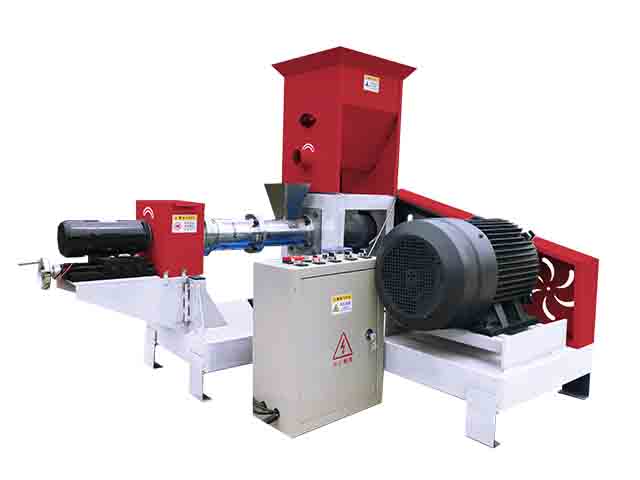
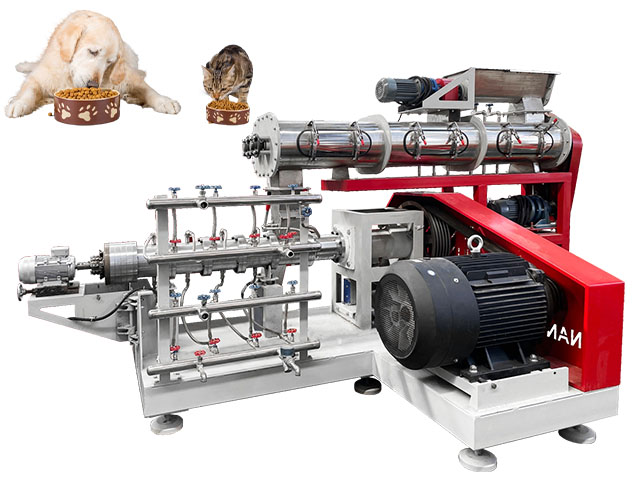
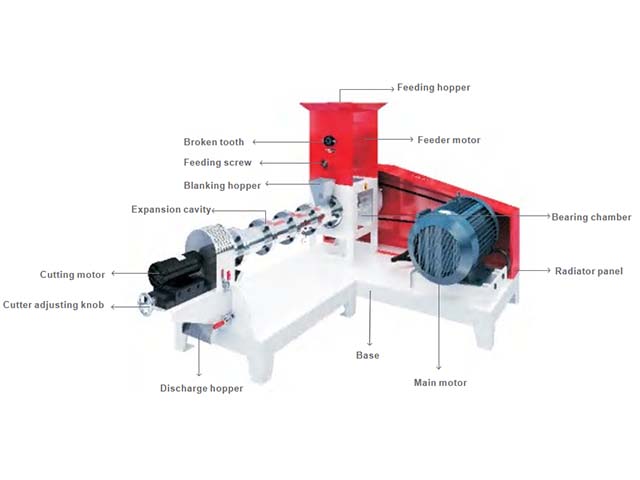
Dry Fish Feed Pelletizer, also known as Dry Fish Feed Expander, is a small pelletizing equipment without external steam and boiler equipment, relying on electric heating and mechanical friction of screw to produce high temperature and pressure to complete the maturation and expansion of raw materials, and can produce floating and sinking fish feed pellets. With compact structure, simple installation, low investment cost and convenient operation and maintenance, it is very suitable for small and medium-sized feed processing plants and start-up aquaculture projects.
Working Principle
Dry fish feed pelletizer production process is simple and efficient, the production of corn and soybean meal fish meal and other feed materials first into the equipment tempering area, and then by the screw continues to push the extrusion of raw materials and high-speed friction to form a high-temperature and high-pressure environment so that the raw materials in the closed chamber to complete the starch pasting and puffing modification of the final puffed material through the customized die holes are extruded and cutter cut into a uniform size of the fish feed particles!
What is Wet Fish Feed Pelletizer?
Core Definition of Wet Fish Feed Pelletizer
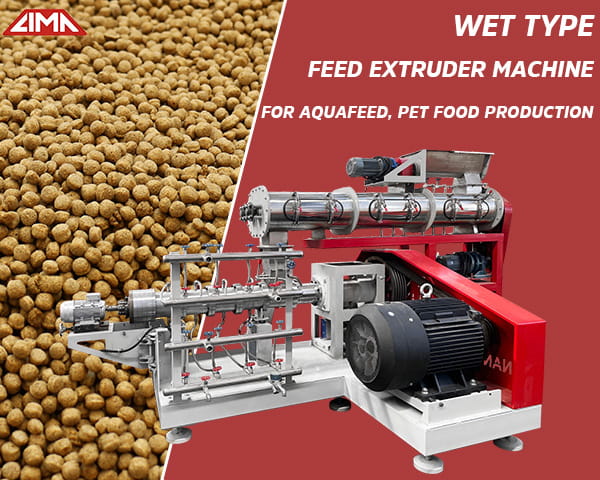
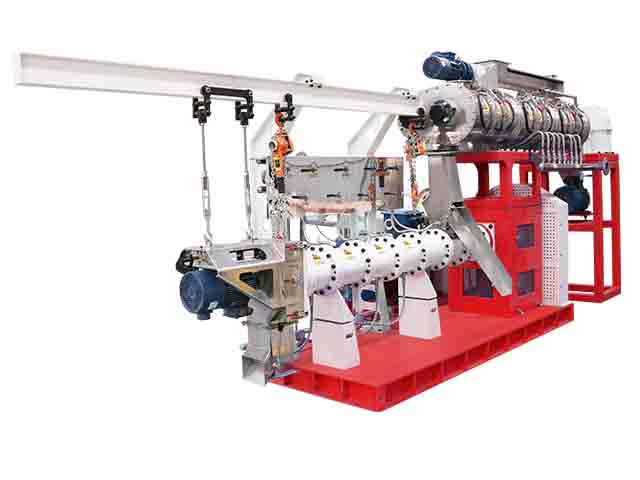
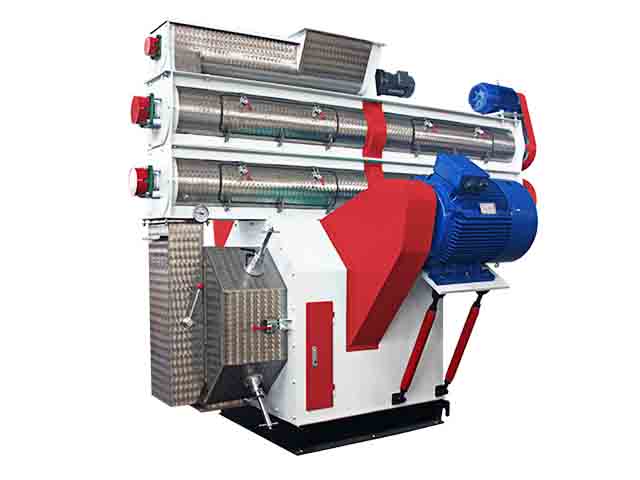
Wet fish feed pelletizer, also called wet fish feed expander, is a special equipment for large-scale production of high-end aquatic feed, compared with dry equipment, the biggest advantage is equipped with steam conditioning system, through the boiler steam on the raw material preheating humidification and pre-cooking, effectively enhance the starch paste degree and feed digestibility, the finished particles molding stability and good water resistance, the equipment contains a single-screw and twin-screw styles, which is the twin-screw model mixing The equipment includes single-screw and twin-screw models, among which the twin-screw model has uniform mixing and controllable parameters, which is more suitable for the mass production of high-quality standardized feed.
Working Principle
Wet fish feed pelletizer adopts the fine production process of steam tempering and high-pressure expansion, when the feed material is mixed with saturated steam in the boiler to warm up and humidify to accurately control the temperature and humidity to complete the pre-cooking, so that the starch dextrination rate can reach more than 80% higher than that of the dry equipment pre-cooking materials, and then extruded by the expansion chamber after the second in-depth cooked to produce stable quality of floating and sinking fish feed pellets The whole set of process can effectively lock the raw material nutrition to enhance the stability of the feed structure and the stability of aquatic feed. The whole process can effectively lock the nutrition of raw materials to improve the stability of feed structure and the palatability of aquatic food.
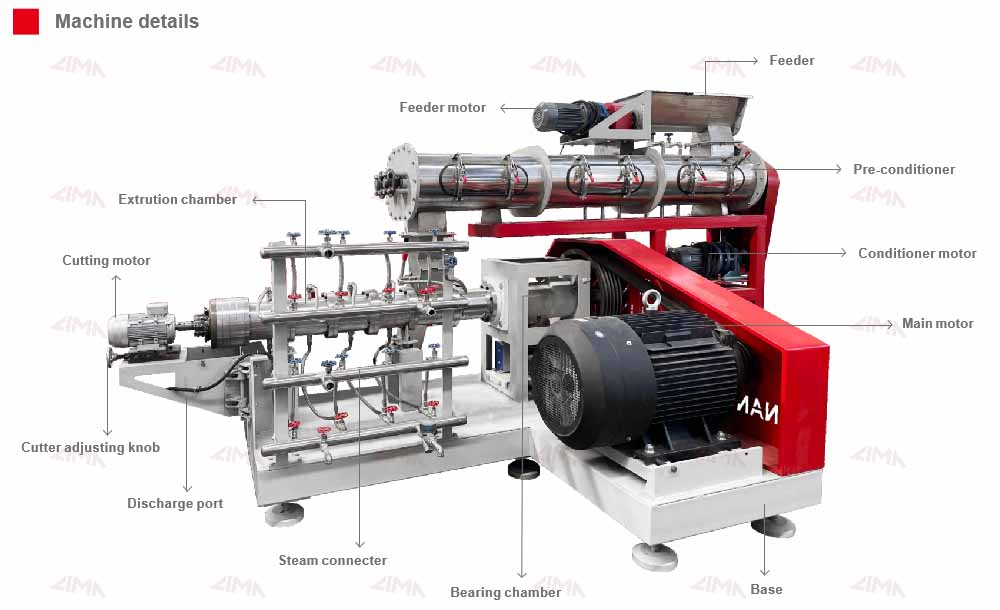
Wet VS Dry Fish Feed Pelletizer
Accurately distinguishing the core differences between the two types of equipment is the key to equipment selection. The following table from the investment, configuration, capacity, quality, operation and maintenance of the whole dimension comparison, to help you quickly lock the appropriate equipment:
| Comparison Program | Dry Fish Feed Granulator | Wet Fish Feed Granulator |
| Initial investment cost | relatively low | high level |
| Steam Boiler Configuration | No configuration required | must be matched |
| Production capacity | Small and medium-sized capacities | Medium to large capacity, suitable for mass production |
| Finished feed quality | Medium, meets conventional farming | High-end quality, suitable for boutique aquaculture |
| Level of automation | basic automation | Fully Intelligent Automation |
| Energy consumption per unit of production | be on the high side | Lower and more energy efficient in the long run |
| Difficulty of routine maintenance | Simple, low O&M costs | Complex processes and high O&M requirements |
| Feed Floating Stability | moderate | Excellent, floats for a long time |
| Adapted user groups | Start-ups, small farms | Commercial large-scale feed processing plant |
Dry and wet fish feed pelletizer is the core equipment for aquafeed production, with significant differences in process, cost, quality and suitability scenarios, which can meet different scale of production needs. The dry method adopts pure mechanical friction expansion process without boiler and steam supporting facilities, simple structure, convenient installation, low input and operation and maintenance costs, and is suitable for small and medium-sized production capacity of less than one ton per hour, which is suitable for start-up factories and small farms with limited budgets. However, the degree of automation is low, the unit energy consumption is high, the effect of raw material maturation and expansion is general, and the quality of the finished feed is medium, so it is only suitable for conventional aquaculture production. Wet equipment using steam conditioning and high-pressure expansion composite process, the need for supporting steam boilers, the initial investment and operation and maintenance threshold is higher, relying on intelligent automation systems can achieve 24-hour continuous mass production, capacity advantages. Steam tempering can greatly improve the starch pasting degree of raw materials, effectively reduce the unit consumption of mass production and improve the utilization rate of raw materials, and the feed particles produced are regular and uniform, with strong water resistance, excellent floating performance, and high-end quality of finished products, which is fully suitable for the large-scale and high-quality production needs of fine aquaculture and large-scale commercial feed mills.
Core advantages of dry fish feed pelletizer
With the core advantages of high cost performance, low threshold and easy operation, the dry equipment has become the mainstream choice for small and medium-sized feed production projects, with the following specific advantages:
– Cost-effective: equipment procurement pricing pro-affordable, the core advantage is that there is no need to purchase additional steam boilers, steam conveying equipment, and do not need to transform the plant to build a special steam piping system, completely eliminating a large number of equipment purchases, infrastructure renovation, supporting facilities to build the additional expenditure, significantly compressing the project upfront investment costs, effectively reducing feed processing industry It can effectively reduce the entry threshold of the feed processing industry, and is perfectly suited for start-up enterprises, individual farmers and small-scale processing projects that have limited capital budgets and want to test the waters of feed production at low costs, so that a complete fish feed production system can be set up with extremely low investment, and the input-output ratio is very considerable.
– Convenient installation and deployment: the whole machine adopts integrated structure design, neat layout and simple structure, abandoning complicated auxiliary supporting systems and eliminating the need to build complex infrastructures such as steam pipelines and boiler supporting devices, which greatly simplifies the pre-installation process. Equipment factory has completed the core debugging and parameter calibration, high integrity of the entire machine, after the arrival of only a simple fixed machine, connecting water and electricity can quickly complete the installation of docking, without the need for professional large-scale construction team and complex infrastructure projects, can be completed in a very short period of time to complete the trial operation of the equipment, rapid commissioning, and effectively save a lot of installation cycle and the deployment of the cost is very suitable for newcomers to quickly get started on the production. Occupies a small space: the entire machine adopts the integration of the whole system, which is very suitable for newcomers to quickly start production.
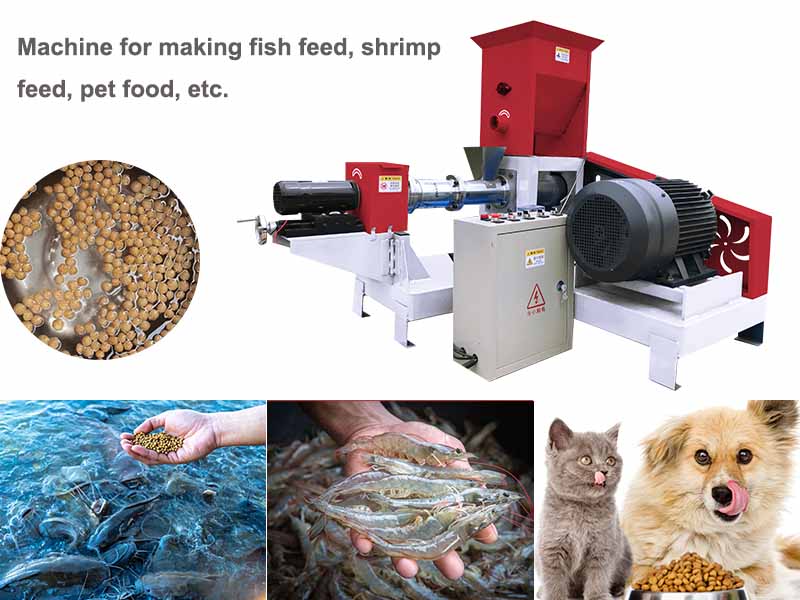
– Occupies little space: the whole machine adopts integrated compact body design, highly integrated structure, abandoning the huge and complicated split structure of traditional pelletizing equipment, no need to match with the boiler, steam piping and other ancillary facilities to occupy additional space, the overall footprint is extremely small. This lightweight body design is highly adaptable to various types of small plants, self-built breeding workshops, new production sites with site constraints, without the need to spend high costs to expand or renovate the plant, can make full use of the limited production space to complete a complete set of feed processing operations, greatly saving the site leasing and infrastructure investment, is very suitable for small and medium-sized production scenarios on the ground to use.
– Fast production speed: the dry fish feed pelletizer abandons the complicated pre-process of steam preheating, pipeline warming, equipment standby debugging and other complicated pre-processes of the wet equipment, and the whole machine operation process is extremely simple to truly realize that the machine can be put into production without waiting for a long time for the equipment to preheat and stabilize the pressure. The equipment is flexible and controllable, perfectly adapted to intermittent production, small batch customized production, temporary replenishment production and other diversified production scenarios, without the need for fixed mass production scheduling mode. It is highly adaptable to the needs of small-scale farms for self-use, start-up factories for small single trial production, and multi-formula rotation production, which can quickly respond to the production needs, greatly enhance the flexibility of production, effectively avoiding the waste of equipment and production capacity, and further enhance the overall production efficiency.
– Low operation and maintenance cost: the overall mechanical structure of the dry fish feed pelletizer is simple and neat, with few parts and components and no complex steam seal, pipeline pressure regulator, boiler matching and other easy to wear and tear system, the equipment running stability is very strong, greatly reducing the probability of frequent equipment failures, and effectively avoiding the production downtime loss. The daily maintenance process of the equipment is simple and easy to operate, without the need for professional and technical personnel to special duty maintenance, only routine cleaning and dust removal, screw inspection, simple lubrication can be completed daily maintenance, maintenance threshold is extremely low. At the same time, equipment wear parts cost-effective, easy to replace, low maintenance costs, there is no high cost of late operation and maintenance expenses, long-term stability and durability, can continue to control the overall production and operating costs, for small and medium-sized production projects, greatly reducing the late maintenance of the equipment capital and manpower investment, long-term operation cost-effective advantage is very obvious.
Dry equipment specifically for the start-up feed enterprises, small aquaculture base tailored to feed industry entrepreneurs to provide a low-risk, highly flexible entry program.
Wet fish feed pelletizer core advantages
Relying on the advanced steam tempering process, the wet equipment has significant advantages in finished product quality, production efficiency and long-term return rate, and is the core equipment for large-scale and high-end feed production, with the following specific advantages:
– High starch pasting degree: relying on the exclusive steam tempering process, the saturated steam can omni-directionally and evenly penetrate into the interior of all kinds of feedstuffs to realize mild and sufficient in-depth maturing treatment, effectively breaking through the short board of insufficient maturing degree of the dry equipment and greatly improving the starch pasting rate of raw materials. The highly pasted starch can fully release the core nutrients such as protein and carbohydrates in the raw materials, dismantle the indigestible crude fiber structure and greatly enhance the overall nutritional value of the feeds, so that aquatic fish can quickly absorb the nutrients and efficiently transform the energy for growth after eating, which significantly improves the digestion and absorption rate, effectively reduces the burden on the fish intestinal tract, lowers the incidence of diseases, and contributes to the rapid and healthy fattening of the fish.
– Excellent pellet quality: Relying on the precise and stable steam tempering and high-pressure expansion composite technology, the fish feed pellets produced by the wet equipment have excellent molding effect, with the overall shape of neat and rounded, uniform size, and uniform and full density, which eliminates common quality problems such as mutilated pellets, uneven sizes, rough surfaces, and hollow and cracked pellets, and the finished products are exquisite and beautiful in appearance. Compared with the feed particles produced by the dry equipment, the finished products of the wet method are greatly upgraded in quality, with higher overall delicacy and regularity, which can not only meet the feeding standards of high-end aquaculture, but also have strong visual advantages and product competitiveness in the feed commodity sales market, which is more suitable for the market demand of high-quality feeds, and can help the production enterprises to improve the product grade and the market price premium space.
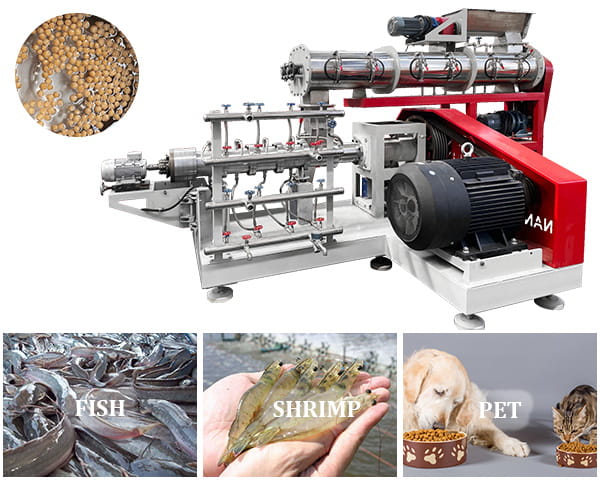
– Excellent floating performance: relying on the steam tempering and high-pressure expansion of the composite process, the feed material will form a uniform and fine closed porous structure after full maturation and expansion, so that the structure of the floating feed particles molded is extremely stable, which completely solves the problem of ordinary feed being loose in contact with water and sinking to the bottom in a rapid collapse. The floating rate of the finished feed produced by the equipment is extremely high, and the floating rate of the standard finished product can be stably maintained at over 95%. It has strong ability to resist water immersion in clear water, aquaculture pond water and other conventional water environments, and it can realize long time suspension without settling and disintegration, which is effectively adapted to various types of feeding modes of floating aquatic products. Excellent floating performance not only allows fish to fully feed on their own, reducing the waste of food grabbing, but also avoids the residual bait from sinking to the bottom and corrupting and polluting the water quality, significantly reducing the maintenance cost of aquaculture water, and at the same time, avoiding bait depletion and deterioration of water quality due to the settling of feed and other aquaculture problems.
– Higher farming efficiency: the feed particles produced by wet process equipment after full steam maturation treatment have a fluffy and crispy taste, excellent palatability, and the highly matured raw material nutritional structure is more suitable for the gastrointestinal digestive system of aquatic fishes, which is very easy to be rapidly consumed and absorbed by fishes, and significantly reduces the feeding coefficient of feeds from the root. High-quality feed palatability can effectively stimulate the desire of fish to eat, eliminate picky eating, less food, food refusal, etc., eating efficiency is faster, more uniform feeding, completely reduce feed residues and feeding waste. At the same time, the significant increase in the conversion rate of feed nutrients can accelerate the growth rate of fish, shorten the breeding cycle, effectively reduce the probability of various types of gastrointestinal diseases and stress diseases in fish, significantly increase the survival rate of aquaculture and the overall yield, and help farmers to reap higher farming income at the same density and cycle, with the comprehensive economic benefits of aquaculture far exceeding that of the conventional dry feed feeding mode.
– Suitable for continuous mass production: the wet fish feed pelletizer is equipped with a full set of intelligent automatic control system, with strong linkage and stable and mature operation logic, realizing the integrated operation of automatic feeding, tempering, expanding, pelletizing and conveying, which greatly reduces the manual intervention and human error in operation. The equipment is tuned by precision technology, mechanical durability and stability of working conditions is very strong, can support 24 hours of uninterrupted continuous operation, no frequent shutdown debugging, warming up and waiting for problems, a complete breakthrough in dry equipment can not be a long time to continue the limitations of mass production. For large-scale feed processing plants with large-volume, standardized, order-based commercial production needs, the equipment can stably output sufficient capacity to ensure that the quality, specifications, and puffing effect of each batch of feed is highly uniform, effectively shorten the production cycle, improve the efficiency of order delivery, and perfectly match the large-scale batch production and long-term stable commercial mode of operation, which significantly improve the overall production efficiency and market order-taking ability.
Wet process equipment mainly focuses on high-end commercial feed production and large-scale processing plant, although the initial investment is higher, but with the high quality of finished products and efficient mass production capacity, it can help enterprises to build high-end feed brand, enhance market competitiveness and realize long-term stable profit.
Accurate selection guide for wet and dry equipment
No need to blindly follow the trend of equipment selection, the core of the combination of their own capacity needs, budget, feed positioning, plant conditions and comprehensive judgment, the following precise selection criteria:
Selection according to production capacity
Capacity of 1 ton per hour or less of small farms and start-up factories are more suitable for the dry fish feed pelletizer equipment, low investment, fast production and flexible operation to fully meet the demand for small batch production, while more than 2 tons per hour of continuous production of large-scale production scenarios are given priority to choose the wet fish feed pelletizer, the equipment in the high-capacity working conditions run more stable and more uniform quality of the finished product can effectively reduce the unit cost of production.
Selection according to investment budget
Start-up projects with limited budgets are more suitable for preferring dry process equipment, which does not require additional boiler supporting costs and has a lower investment in the whole machine and a more controllable production risk. Production projects focusing on long-term large-scale operation are more suitable for choosing wet process equipment. Although the initial investment is higher, the unit energy consumption and operation and maintenance costs are lower in mass production, and the long-term ROI is much higher than that of the dry process equipment.
Selection according to feed quality requirements
The production of conventional standard feed and mainly sinking feed, the use of dry equipment can fully meet the production needs of more cost-effective and stable output of qualified conventional aquaculture feed if the production of highly digestible, high-floating, high-fat formula of high-end floating feed, you must use wet equipment based on steam conditioning and high-pressure expansion process to achieve the depth of raw materials to achieve uniformity of expansion of the finished product, nutrients retained intact and more water-resistant to be more fully adapted. High-end aquaculture feed production standards
Selection according to plant infrastructure
The production site does not have a boiler supporting system is highly recommended dry equipment without steam heat source rely on electric heat and friction can complete the production is very suitable for the infrastructure is not perfect for the new plant if the site is already equipped with a steam boiler system can be maximized to play the advantages of the wet equipment can rely on existing equipment to reduce the energy consumption of the steam production to take full advantage of the production characteristics of the wet process of high-quality high-capacity.
Selection according to long-term energy-saving needs
Enterprises that focus on long-term energy saving and cost reduction, and sustainable production, give priority to wet process equipment. Although the overall power of the wet process equipment is higher, with the efficient steam conditioning process, the raw material maturation efficiency is greatly improved, and the energy consumption per unit of feed under large-scale production is much lower than that of the dry process equipment, which can save a lot of operating costs in the long term.
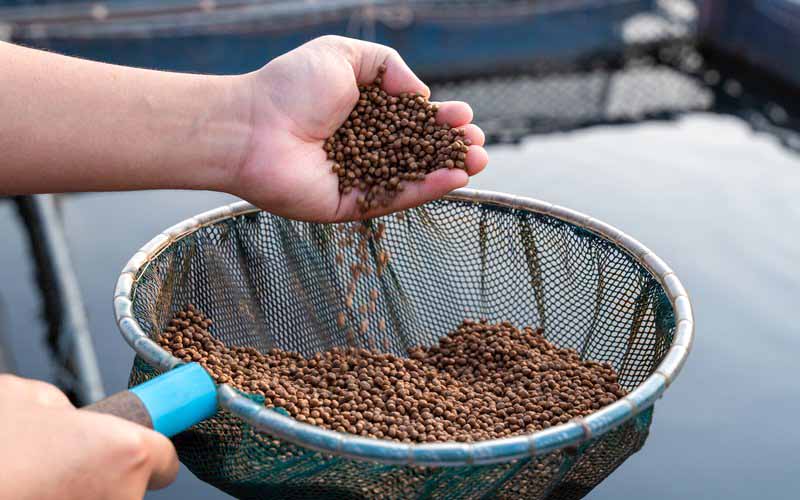
Which equipment is better for the production of floating fish feed?
Floating fish feed production core requirements
Floating fish feed is the most widely used feed in aquaculture. The core of this kind of feed production is to ensure that the pellets have a long-lasting floating ability and are not easy to collapse in water, and also have a good palatability and nutrient absorption effect. Therefore, the precision of the pelleting equipment’s expansion process and the degree of raw material starch maturity have a very high level of production standards, which will directly determine the effect of the finished feed’s aquaculture use.
Wet process equipment is suitable for high-end floating feed production
In the large-scale production of high-end high-quality floating feeds, wet fish feed expanders have absolute technological advantages. The steam conditioning process of the equipment can greatly improve the degree of raw material starch pasting, so that the formed feed particles form a stable and uniform porous structure to optimize the floating performance of the feed in all aspects of the water-resistant and water-absorbent effect of the finished product, and feed floatation can be stabilized to more than ninety-five percent of the floating time can reach twelve to twenty-four hours of particle uniformity. Twelve to twenty-four hours particle uniformity and density controllability can be perfectly adapted to bass trout grouper South American white shrimp and other high-end aquaculture feed production needs.
Dry equipment for conventional floating feed production.
For small-scale production scenarios and start-up aquaculture projects, the dry floating fish feed pelletizer can fully meet the demand for conventional floating feed production. The equipment relies on high shear force and instantaneous high temperature to complete the expansion of raw materials through the optimization of raw material formulas and debugging of equipment parameters can be used to produce qualified general floating feed with the core advantage of low purchase cost, simple operation and convenient operation and maintenance. It has become a cost-effective and practical equipment for small farms and start-up feed factories to mass produce regular floating feed.
Buyer’s Frequently Asked Questions (FAQ)
Which kind of fish feed pelletizer consumes less energy and saves more power?
In small-scale production scenarios, the energy consumption of dry equipment is more controllable, no boiler assistance is needed, fewer supporting equipment, lower overall energy consumption, and simple to build. However, in medium and large-scale mass production scenarios, wet equipment with higher production efficiency and raw material maturation efficiency, the comprehensive energy cost of a single ton of feed is lower, and long-term energy-saving advantages are significant.
Is the wet fish feed pelletizer worth investing in?
For large-scale, commercial feed producers, wet process equipment is definitely worth investing in. The feed particles produced by wet process equipment have high degree of expansion, good nutrient retention, high digestibility and absorption rate, low feed coefficient, and can be adapted to high-fat and high-end feed formulations. Although the initial investment in equipment and infrastructure is higher, but with the high quality of the finished product selling price, lower breeding loss, higher mass production efficiency, most commercial production lines can return to the capital in 1-2 years, long-term profitability far exceeds the dry method equipment. For small-scale self-use farming scenarios, dry equipment can meet the basic needs.
How to choose the right capacity?
The capacity of the equipment needs to be selected in combination with the current production demand and future expansion plans:
– Small capacity (50-300kg/h): Suitable for small farms and start-ups, prefer dry equipment;
– Medium-sized capacity (300-1000kg/h): suitable for growing feed enterprises, according to the quality requirements of the choice of dry or wet equipment;
– Large capacity (1-10 tons/h): commercial large-scale feed mills, uniformly preferred wet expansion production line.
Suggestions for selection: equipment capacity is recommended to be 20%-30% higher than the current actual demand, reserving space for capacity expansion, while avoiding the capacity gap caused by equipment maintenance.
How long is the service life of fish feed pelletizer?
The service life of a regular high quality fish feed pelletizer can reach 8-15 years under the premise of standardized operation and regular maintenance (10,000-20,000 cumulative working hours). The service life of the equipment mainly depends on the regular maintenance and replacement of the screw and barrel, the impurity content of the raw material, the lubrication and cooling maintenance of the equipment, the professionalism of the operator and other factors. Dry process equipment is simple in structure, and routine maintenance is more convenient; wet process equipment needs to focus on sealing and rust maintenance due to steam working conditions. High-quality manufacturers can provide a full set of accessories and after-sales maintenance services to maximize the extension of equipment life.
Summarize
The core difference between wet and dry fish feed pelletizing machine lies in the production process and product positioning, dry equipment, low cost, simple operation and maintenance, suitable for small and medium-sized start-up projects and conventional feed production, outstanding cost-effective; wet equipment, advanced technology, better feed quality and capacity, suitable for large-scale production of large-scale factories and high-end feed mass production. There is no absolute advantage or disadvantage in equipment selection, just combine with your own budget, capacity requirements, feed category and plant conditions. If you have selection problems, you can consult our professional team, we will combine with the actual production conditions to customize the exclusive pelleting program, to provide full technical support, to ensure high efficiency, low consumption and stable production.