How to Start a Goat Farming Business
1. Benefits and Market Potential of Starting a Goat Farming Business
Culture core advantage
Multiple profit channels and product advantages
Goat is a multifunctional economic livestock and poultry, the whole body can produce income, the core output covers mutton, goat milk, cashmere, sheep dung, sheepskin, etc., but also can provide vegetation cleaning, land management and other value-added services, the industrial chain covers a wide range. Goat milk can be processed into cheese, yogurt, handmade soap and other deep-processed products, greatly improving the added value of products and creating multiple profit channels for farmers.
Low cost and adaptability
From the perspective of breeding cost and operational advantages, the entry threshold for goat breeding is extremely low. Compared with beef cattle and pig breeding, goat has lower initial investment and daily operation cost. It does not need large-area breeding site. Simple shed and strong fence can meet the basic breeding demand. At the same time, goats have strong foraging ability, and can eat weeds, shrubs, crop straws and other side feeds, which can greatly reduce the purchase expenditure of concentrated feed and effectively control the breeding cost.
High reproduction efficiency and fast return speed
High reproductive efficiency and fast return speed are the core advantages of goat breeding. Female sheep can reach sexual maturity at 7-12 months, pregnancy period is only about 5 months, and multiple birth rate is extremely high, generally can produce two lambs, three lambs, flock size can be rapidly expanded. As long as the breeding management standard, 12-18 months can realize the finished sheep market, goat milk sales, rapid withdrawal of funds, suitable for beginners to make quick profits.
2. How to Choose the Best Goat Breed for Your Farm
Clarify core farming objectives
The first step of seed selection is to clarify the core breeding target, give priority to determining the main business form, and the secondary income can be subsequently superimposed to avoid dilution of breeding benefits caused by mixed varieties and functions. With milk production and dairy products as the core, the dairy or dual-purpose varieties should be optimized; with meat sheep and fresh meat sales as the target, meat varieties with fast growth speed, full muscle and high meat yield should be selected; cashmere and mohair should be mainly produced, and special wool products should be selected.
If the main focus is on wasteland management and weed cleaning, priority shall be given to extensive varieties with strong ability of coarse breeding and foraging; family breeding and youth research projects are suitable for general varieties with small size and mild temperament; if the main breeding sheep is bred and sold, registered improved varieties with stable genes, excellent production performance and traceability shall be selected. Most mature farms adopt the breeding mode of “one main and multiple auxiliary”, focusing on core categories to improve revenue.
Key points for screening core traits of varieties
Seed selection can not only look at the breed name, but also focus on the core traits of a single goat. In terms of productivity, dairy goats pay attention to milk yield and milk fat percentage; meat goats focus on growth speed, muscle fullness and slaughter meat percentage; wool goats focus on cashmere yield and quality. The breeding efficiency of sheep could be improved effectively by selecting individuals with high conception rate, high double lambing rate, good maternal quality and smooth lambing.
Health resistance is the core guarantee of long-term breeding. Goats with strong anti-parasite ability, healthy hooves, stable limb structure and normal bite should be selected first to reduce late epidemic diseases and limb problems. At the same time, individuals with docile temperament and easy control shall be selected to reduce the labor cost and safety risk of breeding. If the main breeding sheep is sold, it is necessary to select registered improved varieties with complete breeding records and CAE, CL and other epidemic diseases to ensure the quality of breeding sheep.
3. How to Plan and Set Up a Successful Goat Farm
Clarify breeding orientation and formulate entrepreneurship plan
Firstly, the core positioning of the farm is clarified, and the main meat, dairy, wool, ecological management or family sideline mode is determined, so as to determine the variety, breeding scale, site matching, manpower allocation and marketing scheme. Comprehensively sort out their own available resources, including land area, start-up funds, idle time, breeding experience and family manpower support, and plan the breeding scale according to their ability.
Investigate the local market in advance, find out the market demand, purchase price, sales channel and downstream purchaser of mutton, goat milk, breeding sheep and organic fertilizer, and accurately match the market demand. Formulate a complete breeding business plan, define start-up costs, daily operating expenses, expected returns, risk prevention and control plans and phased development goals, focus on planning cash flow for the first 12-24 months, and goat breeding profits usually appear after the first breeding cycle.
Novices are advised to start on a small scale. Family sideline breeding can raise 2-10 ewes, and small-scale commercial breeding can start with 15-30 ewes. After accumulating breeding experience and stabilizing the operation model, we can gradually expand the breeding. Excluding land cost, the start-up fund of small family farming is about US $1000-5000, and the start-up fund of small commercial farms is more than US $5000-30000. Fences and sheds are the main expenses in the early stage.
Verify compliance policies and qualification requirements
Before the establishment of the farm, it is necessary to verify the local compliance policy, connect with the local planning and animal husbandry departments, confirm the compliance of the breeding land, the limitation of breeding quantity and the requirements for site withdrawal, and at the same time abide by the relevant regulations of the community owners committee to avoid illegal construction. Complete industrial and commercial registration, breeding filing, livestock and poultry epidemic prevention registration, and abide by relevant regulations on livestock and poultry transportation and identification management.
If it involves the sale of goat milk and mutton processing and sale, it is necessary to strictly abide by the supervision requirements of the health department, handle relevant quality inspection and sales license, and strictly restrict the sale of fresh goat milk in many places, so it is necessary to understand the compliance standards in advance. At the same time, we will formulate manure treatment and water quality protection schemes, supporting aquaculture liability insurance to avoid environmental protection risks and safety risks of aquaculture. Connect veterinarians who are good at ruminant diagnosis and treatment in advance, establish long-term cooperation relationship, and deal with daily epidemic prevention and epidemic outbreak problems.
Site selection and preliminary arrangement
Priority shall be given to plots with high terrain and smooth drainage, so as to avoid low-lying ponding and muddy soil, and reduce the high risk of sheep foot disease and respiratory tract diseases. The site needs convenient transportation, close to water and power supply, convenient for daily feeding, cleaning and material transportation. Shed to avoid the dominant wind direction, give priority to south, southeast construction, winter lighting warm, summer ventilation shade.
The site planning shall give consideration to natural enemy prevention, neighborhood-friendly, far away from the core area of residential area, and avoid breeding odor disturbing residents. For the sites with grazing conditions, rotational grazing zones shall be divided in advance, scientific grazing routes shall be planned, grassland recycling shall be realized, and the breeding probability of parasites shall be reduced.
Selection of High Quality Sheep
Select suitable varieties according to breeding objectives, local climate and breeding ability. Goats are social animals. It is forbidden to raise them individually. At least 2 goats shall be purchased at the beginning. Priority shall be given to introducing sheep from regular breeding bases, selecting breeding sheep with complete disease detection report, healthy posture and excellent production performance, and preventing the purchase of unqualified retail sheep and inferior sheep in auction market. Newly purchased sheep must be kept in isolation for 2-4 weeks, and then reintegrated into the herd after quarantine disinfection. Novices buy healthy ewes first, match them with high-quality breeding rams or adopt artificial insemination technology to ensure breeding quality.
Marketing and scale-up operations
At the initial stage of breeding, connect sales channels in advance, set up direct sales customers, processing plants, supermarkets, catering stores, characteristic markets and other diversified markets, lock slaughtering and processing quotas in advance for meat sheep breeding, so as to avoid slow sales. Actively develop deep-processing products, ecological weeding services and agricultural tourism projects to enhance the added value and overall profitability of single sheep.
Focus on controlling the two core expenditures of feed and epidemic prevention, relying on rotation breeding and high-quality varieties to improve breeding efficiency. After the sheep are stable, the profits will be invested in variety optimization, facilities upgrading, and gradually expanding the breeding scale. Regularly review breeding programs and management data, optimize management models.
Novice breeding needs to avoid several common mistakes: fence construction is not up to standard, buy sheep first and then build site, parasite prevention and control is not in place, breeding density is too high, there is no breeding account, manpower time cost is underestimated, compliance policy is ignored. Relying on scientific planning, fine management and protection, epidemic prevention and control and cost control, small-scale farms can also achieve long-term stable profits.
4. Essential Equipment Needed for Goat Farming
fence protection
Protective fence is the first equipment needed for breeding, which directly determines the success or failure of breeding. The core configuration is 4-5 feet high anti-climbing woven breeding net, ram area needs to be heightened and reinforced, and the net bottom is densified to prevent escape and digging holes. Equipped with intelligent charging protection equipment and inner induction wires, it forms double protection and greatly reduces the probability of escape. It is equipped with special breeding fence doors, load-bearing columns, and fixed hardware accessories to ensure the fence is stable and durable.
Large-scale grazing culture can be matched with mobile electric purse seine and high-intensity fence system to flexibly divide rotation grazing areas. Spare breeding isolation fence, splicing fence, can quickly set up temporary breeding area, lambing area, sorting area, adapt to all kinds of farm scenery.
Shelter habitat
The basic shed is mainly dry and ventilated three-sided open-top and simple barn to ensure a comfortable habitat for sheep. Complete clean bedding, preferably straw, pine shavings can be replaced, cedar bedding is prohibited to avoid stimulating the respiratory tract of sheep. Standardized lambing pens and sick sheep isolation pens shall be configured separately to realize regional feeding and block cross transmission of epidemic diseases. Mobile sheds can be added to grazing farms to meet the needs of temporary habitat in the wild.
Feeding and water supply equipment
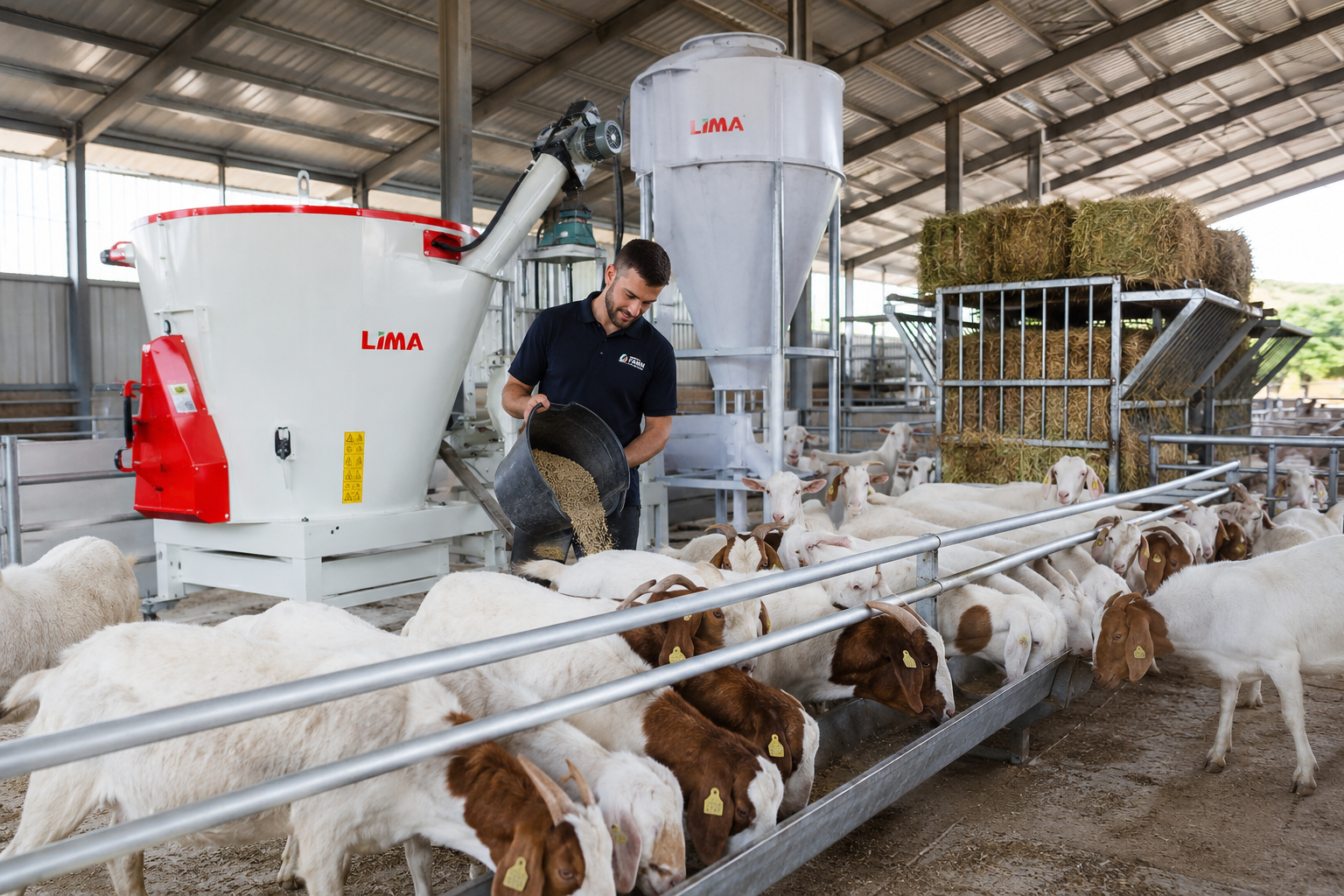
Feeding equipment focuses on solving the problem of feed waste and pollution. Wall-fixed and floor-standing hay racks can avoid hay falling to the ground and mildew. Separated concentrate tanks can prevent sheep from fighting. Special mineral feeder, feeding goat exclusive mineral feed, precise supplement of trace elements.
Water supply equipment includes drinking water barrel, long drinking trough, automatic drinking water device, multi-point layout of water source, to avoid dominant sheep monopolizing water source. Low temperature areas are equipped with constant temperature drinking water barrels and anti-freezing equipment to ensure normal water supply in winter. Feed storage adopts sealed moisture-proof barrel and overhead hay stacking area to prevent rats and mosquitoes from polluting feed and prevent feed mildew.
5. Goat Feeding and Management Practices for Better Growth
Core Feeding Nutrition Principles
The daily dry matter intake of goats is 3%-4% of their own weight. The nutritional requirements will be greatly increased during growth and development, late pregnancy, lactation and low temperature environment, so it is necessary to adjust the feeding ratio in time. Energy, protein, minerals, water and crude fiber are indispensable, which directly determine the growth efficiency and health status of goats.
Energy is the core of goat growth and maintenance of physical fitness. High-quality forage can provide 55%-70% of total digestible nutrients, and concentrate can supplement high-energy nutrients to meet the rapid growth needs. In terms of protein, adult sheep need more than 7% crude protein for daily maintenance, fattening lambs and lactating ewes need more than 10%-16% crude protein, lamb muscle growth highly depends on high-quality protein intake.
Mineral supplements must be formulated specifically for goats. Goats require much more copper than sheep. It is strictly prohibited to mix mineral feeds for sheep. Focus on controlling the ratio of calcium and phosphorus, maintain the optimal ratio of about 2:1, match salt and various trace elements to ensure normal bone development and reproductive function. Crude fiber needs to be maintained at 12%-18%, to protect rumen health and avoid gastrointestinal disorders.
The water supply should be sufficient and clean all day long. Adult goats should drink 1-3 gallons of water per day, and the amount of drinking water should be increased to 2-4 gallons in lactation and hot weather. At the same time, the body condition score is used to control the sheep state. Under the 1-5 score system, the best body condition is 2.5-3.5 points. Too thin and too fat will affect the growth and reproductive performance, so it is necessary to adjust the feed ratio in time.

Phased scientific feeding program
| Feeding phase | Core feeding points | nutrient ratio standard | key considerations |
|---|---|---|---|
| Newborn lambs (0-12 weeks old) | Colostrum must be ingested within a few hours of birth to obtain maternal antibodies; special lamb milk substitute should be used for suckling lambs, and a small amount should be fed many times; starter feed and young hay should be gradually added at 1-3 weeks of age to stimulate rumen development; stable weaning should be carried out at 8-12 weeks of age according to feed intake and weight status. | It is mainly composed of breast milk/lamb milk substitute, and is matched with digestible starter and tender hay in stages to ensure 0.3-0.5 pounds per day gain. | It is forbidden to wean suddenly to avoid stress of lambs; strictly control feeding frequency and food intake to prevent excessive gastrointestinal burden and ensure stable weight gain. |
| Weaned lambs/fattening sheep | Natural forage, shrub branches and leaves and leguminous hay are taken as basic staple food, and fattening concentrate is supplemented in gradient; the nutrient concentration of diet is gradually increased in the later fattening period, and the feeding is grouped according to body type and sex to avoid competition for food intake. | The crude protein content of diet was controlled at 14%-18%, mainly by coarse feed and supplemented by concentrate gradient. | It is forbidden to feed concentrate in large quantities at one time to avoid rumen acidosis and enterotoxemia; group breeding to ensure normal feeding and growth of weak sheep. |
| Empty ewes/healthy breeding rams | In good condition, only feed high-quality forage, no need to supplement concentrate, maintain basic physical fitness and healthy posture. | Natural forage is freely eaten to meet the nutrition required for basic growth and physical maintenance. | Regularly monitor the body condition to avoid being too fat and thin, which will affect the subsequent breeding and breeding performance. |
| Pregnant ewes (late 4-6 weeks) | The rapid growth of fetus squeezes rumen space, so it is necessary to supplement concentrate on the basis of forage, improve the overall energy density of diet, and ensure fetal development and ewe physique. | Add an extra 0.5-1.5 pounds of concentrate per day and balance it with quality grass. | Increase feed gradually to avoid overnutrition or gastrointestinal discomfort and ensure healthy fetal development. |
| lactating ewes | Accurate feeding based on milk production, combined with high-quality forage, increases the overall nutrient supply and adapts to the high consumption needs of lactation. | For every 3 pounds of fresh milk produced, 1 pound of concentrate is added to ensure sufficient protein and energy. | Adjust feeding quantity dynamically according to demand, avoid milk yield decrease and ewe body weakness caused by insufficient nutrition. |
| premating ewes | 2-4 weeks before mating, moderate increase of dietary nutrition level, good nutrition stimulation, increase of ovulation rate and pregnancy rate. | On the basis of conventional forage feeding, concentrate and trace elements were moderately supplemented. |
6. Goat Health Management and Disease Prevention
Core principles of disease prevention
Biosafety control is the basis of epidemic prevention. All newly purchased goats must be kept in isolation for 2-4 weeks, with the best isolation period of 30 days. After confirming that they are healthy and disease-free, they shall be incorporated into large groups. Priority should be given to introducing species from regular inspection pastures, and epidemic areas and infected sheep should be prevented from entering. Strictly control the entry and exit of personnel and vehicles in the farm, equip special protective clothing and disinfection equipment, and realize closed breeding as far as possible. Isolate sick sheep immediately to avoid cross-infection and spread of epidemic situation.
Nutrition balance and clean drinking water are the core to improve sheep immunity. Adhere to the feeding mode of coarse feed mainly supplemented by concentrate, supplement special minerals, and eliminate feed mutation and nutrition imbalance. All-weather protection of fresh drinking water, eliminate sewage, stagnant water drinking. The pens should be kept dry, ventilated and of reasonable density, and the feeding equipment and bedding areas should be cleaned and disinfected regularly to cut off the breeding and transmission paths of germs from the source.
Scientific rotation grazing, moderate grazing, avoid grassland over-load, parasite accumulation, use goat foraging habits to clean weeds, improve grassland environment. Daily inspection of sheep status, observation of feeding, behavior, feces, gait, mucosal color, early detection, early intervention of minor diseases, to avoid minor diseases dragged into serious diseases. Complete records of vaccination, medication, deworming and morbidity data, summary of breeding rules, and continuous optimization of epidemic prevention programs.
Scientific vaccination programmes
CDT vaccine is the core basic vaccine of all goats, which can effectively prevent enterotoxemia and tetanus, two fatal diseases. All sheep must be vaccinated regularly. Standardized vaccination procedures should be implemented in conjunction with veterinary advice and vaccine instructions. Pregnant ewes should be immunized 4-6 weeks before birth, and antibodies should be transmitted to lambs through colostrum to enhance the immunity of their pups.
Lambs born by immunized ewes shall be vaccinated for the first time at 6-8 weeks of age, re-seeded after 3-4 weeks, and then regularly reinforced every year; lambs born by unimmunized ewes in high-risk breeding environment can be vaccinated in advance to 1-4 weeks of age to increase immunization frequency. Adult sheep and breeding rams are routinely immunized every year, and the immunization frequency should be increased in sites with large concentrate feeding and high breeding density.
In addition, according to the epidemic situation of local diseases, targeted vaccination of lymphadenitis, pneumonia, abortion, aphtha, rabies and other vaccines can be carried out. Most goat vaccines are used beyond the label, so it is necessary to strictly comply with veterinary guidance and comply with regulations.
7. Goat Farming Startup Costs and Investment Requirements
Start-up fund range of aquaculture of various scales
Family niche breeding (2-10): the start-up capital of mature markets such as Europe and America is USD 1000-15,000, and the standardized and perfect configuration is generally USD 3,000-8,000; in Africa, India and other low-cost areas, the investment is only hundreds to thousands of dollars, and the basic supporting facilities are perfect, and the investment for 2-6 family breeding can be controlled at USD 1500-5,000.
Small-scale commercial farming (15-30): US market investment of more than 5,000-30,000 US dollars; India 20-scale standardized farming investment of about 2,700-4,400 US dollars; other developing countries invest less, adapt to local income levels.
Medium commercial breeding (50 ewes): US meat farms invest US$44,000-132,000, covering seed introduction, complete facilities, breeding equipment, working capital; Indian equivalent scale breeding invests more than 50-700,000 rupees. More than 100 large-scale farms, infrastructure, manpower, equipment investment will increase significantly.
Major investment cost categories
Fence construction is the largest single expenditure in the early stage, 0.5-2 acres of land, US market fence investment of 1500-7000 US dollars, complex terrain, large perimeter site costs higher. Fence quality directly determines the success or failure of breeding, it is strictly prohibited to cut corners, to avoid sheep escape caused losses.
Shed construction according to the scale and climate adjustment, small simple shed investment 500-5000 dollars, cold, moisture, epidemic prevention special high-end facilities cost higher. Optimize the construction scheme with high terrain, good drainage and good ventilation, and reduce the cost of epidemic prevention and control from hardware.
The introduction cost of breeding sheep is significantly different, ordinary meat and dual-purpose adult sheep are 100-400 US dollars, high-quality registered dairy breeding sheep and improved breeding sheep are 250-1000 US dollars, and the price of high-quality breeding sheep is higher. At least 2-3 ewes and 10-20 ewes + breeding rams shall be introduced at the beginning of novice breeding, and additional quarantine and isolation costs shall be reserved.
Breeding equipment consumables, small sheep investment 100-1000 dollars, including feeding equipment, water supply equipment, hoof repair tools, first aid consumables, basic operation and maintenance tools; large-scale, automatic breeding equipment investment is higher, can greatly save labor costs.
The turnover reserve fund is very important. The profit cycle of the first round of goat breeding is 12-24 months. Sufficient funds shall be reserved to cover the early feed, labor, veterinary and emergency expenses, so as to ensure that the farm can smoothly pass the initial period.
8. Goat Farming FAQ
Suggestions for starting farming quantity
Goats are social animals, alone easy to stress, anorexia, illness, absolutely prohibited single breeding, at least 2 breeding. Novice family sideline breeding, it is recommended to start 2-6, simple operation, extremely low risk, controllable investment; small-scale commercial mutton sheep breeding, starting 15-30 ewes, convenient for large-scale management and batch output. After mastering the breeding technology skillfully and stabilizing the operation mode, gradually expand the breeding and steadily expand the scale.
Area requirements for breeding sites
Goat farming does not require large areas of land, and is suitable for small sites for entrepreneurship and family farming. Mini-goat breeds require less space, and standardized breeds require only reasonable shelter habitat, activity area and grazing area. Relying on rotational grazing mode and refined site management, small-area sites can also realize efficient breeding. The core is to strictly control the breeding density, avoid excessive breeding leading to parasite breeding, dirty environment, limited growth, and ensure the health of sheep.
Qualification and compliance requirements
Before breeding, it is necessary to verify the compliance of local land breeding, withdrawal requirements of residential areas, breeding quantity limit, community management regulations, complete breeding filing, industrial and commercial registration, livestock and poultry epidemic prevention registration. If fresh milk sales, mutton processing and product sales are carried out, additional hygiene license, quality inspection filing and business license shall be handled, and livestock and poultry identification and transportation management regulations shall be observed. It is suggested to connect with local agricultural extension departments and animal husbandry stations at the initial stage to fully understand local policies and avoid compliance risks.
A Guide to Quality Variety Selection
The core of novice seed selection follows the principle of “adapting to local conditions and selecting seeds according to needs”. Boer goats and Savannah goats with fast growth and high meat yield are preferred for meat; Saanen goats, Alps sheep and Nigeria dwarf milk sheep with high milk yield and high milk fat quality are preferred for dairy use; basic family goats and Spanish goats are preferred for disease resistance and rough breeding to adapt to novices and poor breeding environment; cashmere and mohair special varieties are preferred for cashmere breeding, which can be accurately selected in combination with their own breeding objectives and regional climate.